
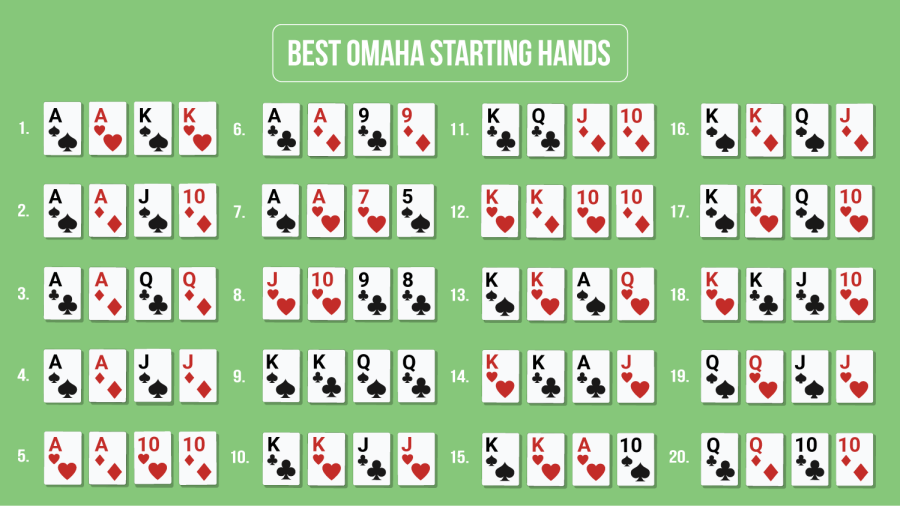
ggcea.org– Omaha can feel generous. You get four hole cards, so you assume you’ll hit something. And you will—often. The catch is that everyone else hits something too. That’s why omaha poker hand rankings aren’t just about memorizing which five-card hand beats which. In Omaha, the real ranking question is: “How often is my hand the best possible version of that hand?”
That’s also why people search Omaha poker starting hand rankings. Starting hands matter in Omaha because weak starters don’t just miss—they hit “second-best” and lose quietly.
First, the rule that changes every ranking
In standard Omaha, you must make your final five-card hand using:
-
exactly two of your hole cards, and
-
exactly three community cards.
This is the rule that prevents “playing the board” and forces you to think differently than Texas Hold’em. It also changes what hands are “live” on certain boards.
Hand rankings at showdown (the same ladder, different meaning)
At showdown, Omaha uses the same classic poker hand ladder:
High Card → One Pair → Two Pair → Three of a Kind → Straight → Flush → Full House → Four of a Kind → Straight Flush
So what’s different? Frequency and danger.
In Omaha, straights and flushes appear more often because players start with more combinations. That means a straight or flush is less “special” than it feels in Hold’em—especially if it isn’t the nut straight or nut flush.
Practical translation:
-
In Hold’em, a decent flush often wins.
-
In Omaha, a non-nut flush often gets you into trouble.
The Omaha mindset: “nut” hands and redraws
If there’s one concept that defines winning Omaha poker hands, it’s this: aim for nut potential and redraws.
-
Nut potential means your hand can make the best possible flush/straight/boat on many boards.
-
Redraws mean that even if you’re ahead now, you have extra ways to improve or stay ahead if the board changes.
Example: Having the ace-high flush draw is better than having the queen-high flush draw—because if the flush completes, you’re less likely to be dominated. In Omaha, domination happens a lot.
Omaha poker starting hand rankings (a practical tier system)
There isn’t one universal “perfect chart” because table size and betting structure change things. But for most beginners learning Pot-Limit Omaha, you can think in tiers based on coordination, suits, and high cards.
Tier 1: Premium double-suited, connected, high cards
These hands have:
-
strong pairs or high card strength
-
connectivity (straight-making ability)
-
two suits (more flush potential)
-
good “nut” paths
Examples (formats, not exact cards):
-
A-A-x-x double-suited (especially with connected side cards)
-
A-K-Q-J double-suited
-
A-K-Q-T double-suited
-
K-Q-J-T double-suited
Why they rank high: they make top pairs, nut straights, nut flushes, and often have multiple redraws.
Tier 2: Strong single-suited, connected broadways and good pairs
These hands still have structure but fewer premium features:
-
single-suited A-high hands with strong connectivity
-
high pairs with helpful side cards
-
connected hands that can make nut straights
Examples:
-
A-K-J-T single-suited
-
K-Q-J-9 double-suited
-
J-T-9-8 double-suited
-
K-K-Q-J with suit support
Tier 3: Coordinated “wrap” starters without ace support
These hands can flop huge draws (wraps), but can also run into higher versions:
-
Q-J-T-9 (especially suited)
-
J-T-9-8 (especially suited)
Good in position, dangerous out of position, and more sensitive to table style.
Tier 4: Hands that look pretty but bleed chips
These are common traps:
-
disconnected cards (no straight structure)
-
low pairs without backup
-
“one-suit but not nut” hands
-
rainbow hands with no coordination
They hit weakly and force you to guess on later streets.
Quick guide: which made hands you should trust
When you actually connect with the board, here’s the trust hierarchy that helps beginners:
-
Nuts (best possible hand): trust it, value it
-
Near-nuts with redraws: often playable
-
Non-nut flushes/straights: treat as suspicious, especially multi-way
-
Two pair: often fragile in Omaha
-
Top pair: rarely a hand to build a big pot with
Omaha punishes pride. If you want to stay sane, respect how often someone has a better version.
Common beginner mistake: overvaluing small pairs
In Hold’em, a small pocket pair can be a decent set-mining hand. In Omaha, pairs are less clean because you must use exactly two hole cards and the board is shared with more opponents holding more combinations.
Sets still matter—but they’re not automatic license to go big, because boards can complete straights and flushes quickly, and full houses become the real premium on paired textures.
One subtle insight most beginners miss
In Omaha, a hand can be “strong” and still be a bad bet.
Example: you flop a straight, but it’s the bottom straight on a connected board. That straight might be ahead right now, yet your opponent could be drawing to a higher straight, a flush, or a boat depending on the board. Your hand’s value depends on:
-
whether it’s the nuts
-
how many players are in the pot
-
whether you have redraws
That’s why Omaha feels swingy to new players: they make a hand, then discover it wasn’t the right version of the hand.
The official omaha poker hand rankings match classic poker, but the practical reality is different: more made hands collide, and the nuts matter more. If you want a clean foundation for Omaha poker starting hand rankings, prioritize double-suited coordination, high-card strength, and hands that can make the nut straight or nut flush with redraws. That’s how you build Omaha poker hands that win more often than they break your heart.